Medical disclaimer: This guide discusses dietary supplement capsules containing Moringa oleifera leaf. It is general information, not personal medical advice. Supplements are not intended to diagnose, treat, cure, or prevent disease. If you take prescription drugs, are pregnant or breastfeeding, or manage a chronic condition, consult a qualified healthcare professional before use.
Moringa capsules pack dried, powdered moringa leaf (sometimes with minimal excipients) into a swallowable shell. Shoppers usually land here from a short list of searches: what capsules are, what benefits are realistic, whether men and women differ, how Amazon listings work, why prices swing, and everyday uses that match a busy routine. This page ties those intents together so you can compare format, read labels critically, and avoid the worst marketing traps.
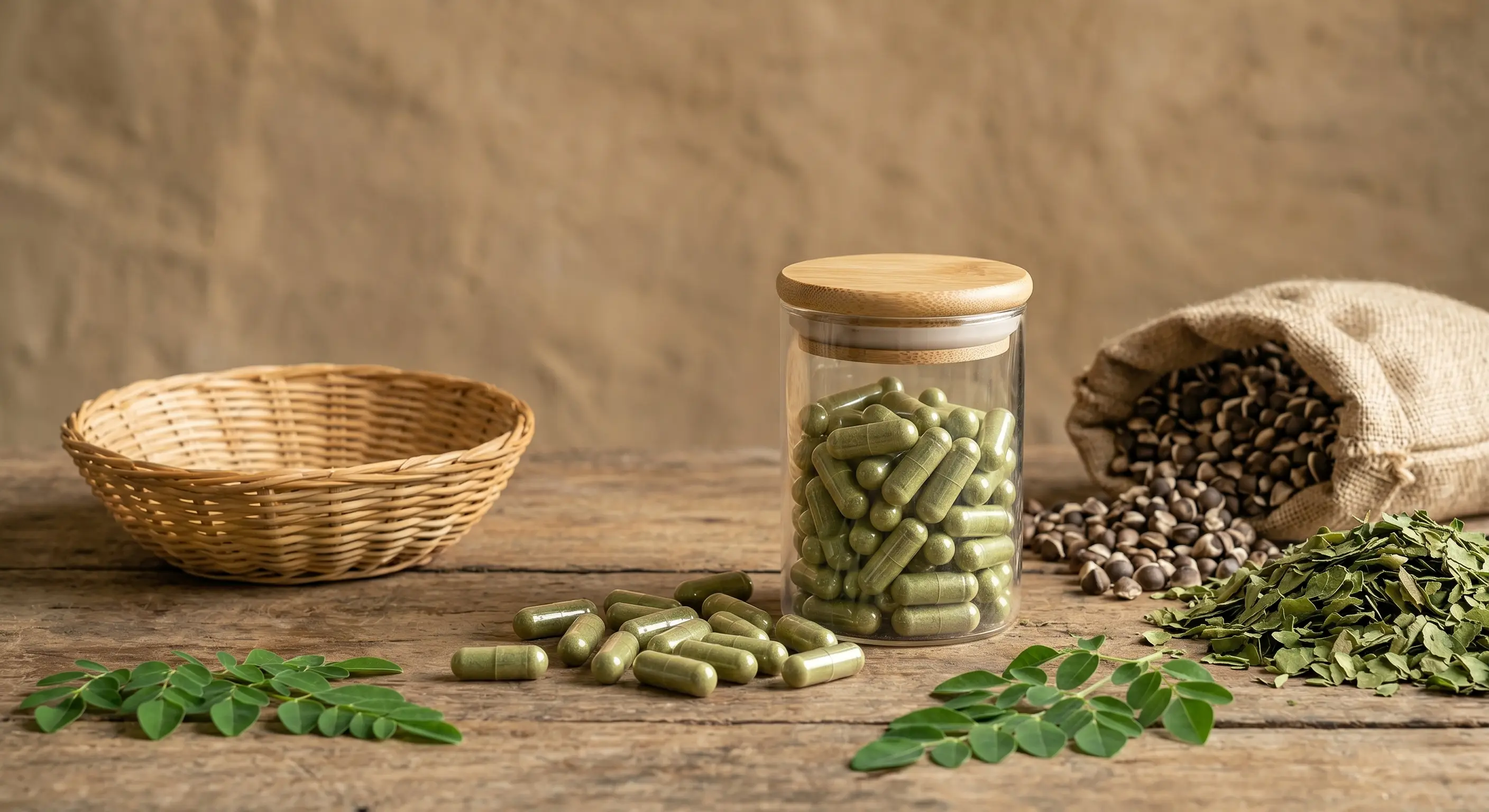
What moringa capsules are (and are not)
Most retail “moringa capsules” are vegetable or gelatin capsules filled with fine leaf powder. They are not the same as high-potency solvent extracts studied in some clinical papers; those extracts use different processing and concentrations. Capsules excel at portion consistency and taste masking. They typically deliver less dietary fiber per serving than stirring a full teaspoon of loose powder into food, because serving sizes are smaller by design. For a deep format comparison, read moringa powder vs capsules before you stock both SKUs in your cabinet.
Moringa capsules benefits (evidence-leaning summary)
Benefit conversations should start with nutrition density: moringa leaf is rich in micronutrients and polyphenols that support the idea of better dietary adequacy when your vegetable intake is weak. Small human trials and animal work have explored oxidative balance, glycemic markers, and lipids, but results vary by population, dose, and extract type. Honest takeaways:
- Dietary insurance: Capsules can help people who travel or skip greens get plant micronutrients they might otherwise miss.
- Habit adherence: Fifteen seconds at the sink beats a blender you never clean.
- Pairing still matters: Vitamin C–rich foods improve non-heme iron context; overall protein and fiber drive satiety more than any green pill.
For weight and glucose nuance, cross-read moringa and weight loss and diabetes context—capsules follow the same evidence limits as powder.
Moringa capsules benefits for women
Women-focused queries often bundle iron, energy, skin, hair, and hormones. Leaf powder inside capsules still carries non-heme iron and antioxidants discussed in beauty and anemia articles; pairing with citrus or other vitamin C sources supports absorption logic from food chemistry. Capsules do not replace prenatal vitamins, prescribed iron, or endocrine care. Pregnancy and lactation deserve individualized advice because supplement concentrations differ from occasional drumsticks in a meal; see safety and interactions before committing during those life stages. For skin and hair framing, continue to hair and skin guide.
Moringa capsules benefits for men
Men’s search funnels often emphasize energy, training, lipids, and sometimes testosterone keywords. Moringa may fit a general wellness stack when diet and sleep are already addressed. Evidence for isolated “testosterone boosting” from standard leaf capsules in healthy adults is not robust enough to treat supplements like medicine. If you have fatigue, libido changes, or strength loss, clinicians interpret labs; capsules should not postpone that visit. Training recovery still hinges on protein timing, hydration, and progressive overload.
Common moringa capsules uses (practical, not magical)
- Travel: Measured counts in a pill organizer; no spilled green dust in a suitcase.
- Office routines: Swallow with water after lunch when smoothie culture does not fit the culture of your workplace.
- Taste avoidance: Children and adults who gag on grassy powders sometimes tolerate capsules better.
- Stack discipline: When you already take other capsules, adding one more is cognitively easier than another powder ritual.
- Short bridging periods: Between seasons when fresh produce access dips—still widen food variety when you can.
Cooking creativity belongs with loose powder; if you want recipes, use daily cooking ideas alongside an occasional capsule on lazy days.
How to read a capsule label (servings, fillers, certifications)
Before you chase moringa capsules price alone, decode the label:
- Mg per capsule vs per serving: Brands differ; “two capsules” may equal one marketed serving.
- Other ingredients: Rice flour, maltodextrin, or silicon dioxide are common flow agents; allergies matter.
- Shell type: Vegetarian HPMC vs gelatin affects ethics and sometimes shelf feel in humid climates.
- Organic claims: USDA Organic, EU Organic, and India NPOP schemes signal audited farm practices but do not remove the need for heavy-metal prudence; bulk buyers should still request COAs.
- Leaf-only: Confirm the ingredient is drumstick leaf, not bark or root, unless you intend otherwise.
Purity red flags mirror powder issues summarized in pure vs adulterated moringa.
Moringa capsules price: what moves the number
Retail prices fluctuate with country, currency, promotions, bottle count, organic certification, shipping import layers, and Amazon Subscribe & Save discounts. Instead of quoting amounts that go stale overnight, use a cost-per-gram of leaf powder equivalence heuristic:
- Find total grams of moringa leaf per bottle (capsule mass × count, or serving mass × servings).
- Divide shelf price by those grams.
- Compare against a reputable loose powder listing on the same marketplace.
Often, powders win on raw economics if you consume daily at higher doses; capsules win on convenience tax you may happily pay. Multipacks and larger counts usually lower unit cost; watch expiration dates if you are a light user.
Moringa capsules Amazon: shop without getting mis-listed
Amazon remains the default search engine for supplement SKUs, but listing drift is real. Before you click buy:
- Title vs image vs nutrition panel: Mismatch suggests a stale variant—read all three.
- Review hygiene: Look for recent verified-purchase notes about color, smell, and seal integrity; ignore five-star essays that could apply to any herb.
- Brand storefront: Buying from the brand’s official seller or Amazon’s retail line, when clearly labeled, reduces commingling anxiety compared with random third-party offers.
- International shipping: Labels may differ by marketplace; confirm organic seals match your expectation.
For brand positioning context beyond a single ASIN, compare narratives in Organic India vs Vahdam vs Kuli Kuli. Our product primer also lives under moringa capsules on the site hub.
Dosing realism and timing
Start at or below the label’s beginner direction unless your clinician advises otherwise. Take with food if mild nausea appears on an empty stomach. Split into two times daily when single large servings feel gut-heavy. Log the brand, serving count, and concurrent medications for two weeks when troubleshooting effects. Anyone on anticoagulants, anti-diabetes drugs, or antihypertensives should read interaction cautions in side effects article first.
Side effects and when to stop
Typical issues mirror other leafy green concentrates: digestive upset, loose stools when dose jumps too fast, or rare allergy in sensitized individuals. Stop and seek care for hives, breathing difficulty, or persistent abdominal pain. Quality problems—mold from moisture ingress, rancid oil if blended incorrectly with fatty ingredients—are supply-chain issues; capsules with off smells or cracked desiccant-free bottles deserve a refund request, not a brave swallow.
Who capsules suit best vs who should prefer powder
Choose capsules when adherence beats micro-savings, when travel dominates your calendar, or when taste is a barrier. Choose powder when you want fiber-adjacent bulk in smoothies, want to cook with moringa, or optimize cost per gram at higher daily intakes. Many households keep both: capsules for weekdays, powder for weekend cooking.
FAQ corner
Are capsules weaker than powder? Not inherently—they are usually the same material in a shell; serving size determines delivered mass.
Can I open capsules into food? Yes, if the fill is plain leaf powder; you have effectively converted to powder for that meal.
Do capsules need refrigeration? Cool, dry pantry storage is typical; read label storage lines for brand-specific guidance.
Is there an ideal time of day? Morning vs evening matters less than consistency; split servings if evening doses disturb sleep due to personal GI sensitivity (uncommon but subjective).
Closing
Moringa capsules are a legitimate convenience format for a leaf food that cultures have eaten for generations. They reward label literacy, price-per-gram thinking, and skepticism toward miracle claims. For encyclopedic background on the plant itself, continue with the ultimate moringa encyclopedia; for export and India sourcing depth, anchor from the home buyer guide.
Further reading for bulk buyers
Importers evaluating capsule SKUs should confirm gelatin or veggie shell spec, excipient list for target markets, moisture specification in finished packs, and stability data if you plan tropical distribution. Retail consumers inherit a lighter checklist but the same honesty: if a price looks too cheap for organic leaf and third-party testing claims, verify before ingesting.
Keep reading in this topic cluster
Three to five internal jumps—same silo, different job-to-be-done. (Site map rule: every article links deeper into its cluster plus one conversion path.)
Last updated: May 2026.
Compare on Amazon
Amazon runs checkout, returns, and pricing. Re-check the listing title and organic seal before you order.
Prices and Prime eligibility can change without notice.